
Dead, dying, leaning and unwanted trees
Tree Removal in Pittsburgh, PA
Trees taken down piece by piece where there is no room to drop them, with logs and brush handled the way you want.
- Every estimate done in person around Pittsburgh and Allegheny County
- The quote spells out each tree and task
- Cleanup included and described in writing
Taking Trees Down Where There Is No Room to Fell Them
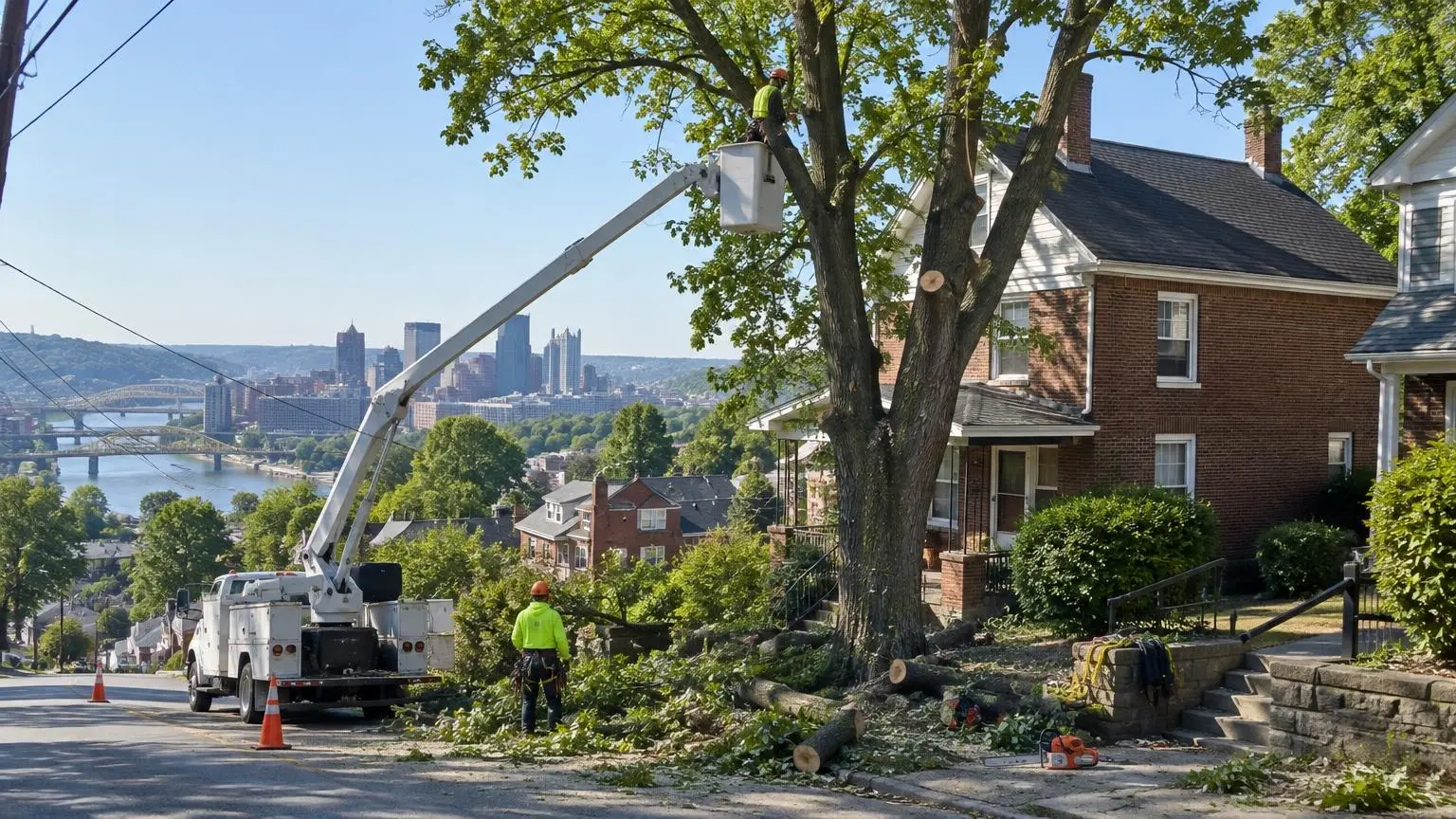
Tree removal in Pittsburgh is mostly sectional work. Very few city lots have a clear landing zone the length of a mature tree, so a climber or a lift takes the crown apart from the top: small limbs first, then larger limbs and finally the trunk in pieces. Anything heavy, or anything above a roof, a wall or a neighbor's yard, is tied off and lowered on a rope instead of dropped. The tree's height matters, but access, what lies underneath and the condition of the wood usually decide how long the job takes and what it costs.
When a tree should come out
Some cases are clear: a dead tree, a large cavity or bracket fungus at the base, a trunk split down a fork, or a fresh lean with cracked or heaving soil on the far side. Others are judgment calls, like a healthy maple that has simply outgrown a 30-foot-wide lot, a Callery pear that drops a major limb every few winters, or a Norway maple with roots wrapped around its own trunk. We tell you what we see, and when pruning or cabling would solve the problem instead, we say so.
Dead ash and other brittle wood
Emerald ash borer was found in Butler County in 2007 and Penn State Extension reports it in every Pennsylvania county. Heavily infested ash die within a few years, and as dead ash dry out the wood gets brittle, so limbs can snap during rigging instead of swinging where they are aimed. That often means more lift work and smaller pieces, which takes longer. The same is true for trees killed by oak wilt or long-dead black locust and cherry on wooded hillsides. Taking a dying tree down before it is fully dead is usually simpler and cheaper.
Street trees, wires and neighbors
If a tree stands in the City of Pittsburgh right-of-way, it belongs to the city. Removing it privately requires a tree work permit through the Forestry Division, and the city asks residents to call Forestry first; the city may also remove hazardous street trees itself. We do not cut near energized lines. Duquesne Light handles conflicts with its wires, and we take down the rest of the tree once the line is clear. For limbs hanging over a neighbor's house, it helps to let the neighbor know before work day, since a climber or ground crew may need a few feet of their yard.
What happens to the wood
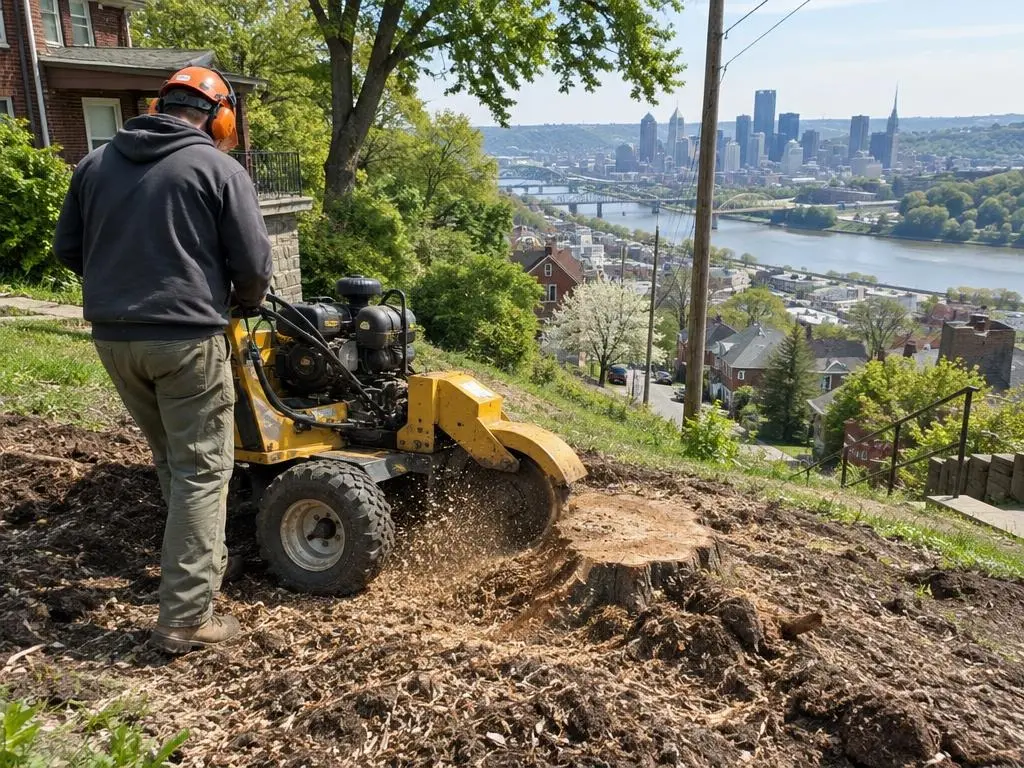
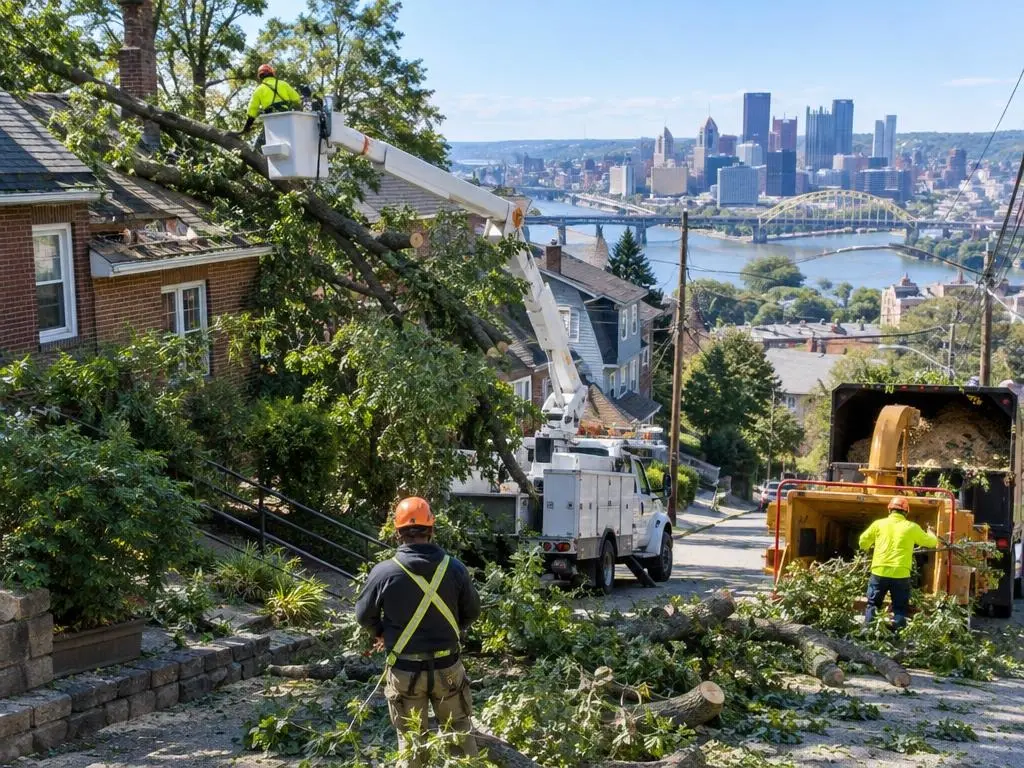
You decide. Logs can be left in rounds, cut to firewood length, or hauled away; brush is chipped, and chips can stay for mulch or leave with us. Pennsylvania's experience with emerald ash borer and oak wilt is the reason to keep firewood local and not carry it to a camp or another county. The stump is its own line on the quote and can be ground the same day or later.
When a crane makes sense
Occasionally a tree is too big, too decayed or too close to a house to climb safely, and there is no way to get a lift to it. In those cases a crane can lift whole sections over the house to the street. It costs more per hour but can shorten a long, risky climb into a few hours, and on some Pittsburgh lots it is the only sensible way. We tell you at the estimate if a job looks like crane work.
Common Jobs
Removal covers taking the tree down and dealing with everything that comes off it.
Sectional removal
Crown and trunk taken apart from the top, with pieces lowered on ropes over roofs, walls and fences.
Dead ash and hazard trees
Ash killed by emerald ash borer, split pears and decayed trees taken down before they fail on their own.
Crane-assisted removal
Whole sections lifted over the house when a tree cannot be climbed or reached safely.
Brush chipping
Branches run through a chipper, with chips left for mulch or hauled off.
Log handling
Wood left in rounds, cut to firewood length or removed from the property.
Common Tree Removal Prices
| Job | Published range |
|---|---|
| Tree removal, Pittsburgh (This Old House) | $308 to $1,356 |
| Tree up to 30 ft (Lawn Love, national) | $285 to $435 |
| Tree 30 to 60 ft (Lawn Love, national) | $435 to $870 |
| Tree 60 to 80 ft (Lawn Love, national) | $870 to $1,160 |
| Tree over 80 ft (Lawn Love, national) | $1,160 to $2,000 |
| Crane-assisted removal, most homes (ArboStar) | $3,500 to $8,000 |
| Log splitting (Lawn Love) | $75 to $100 per tree |
Ranges from This Old House (Pittsburgh), Lawn Love (2026, national) and ArboStar (2026, crane work). Slopes, tight access, dead wood and trees over roofs push prices up. Your written estimate is the price.
How It Works
1. Walk the site
We check the tree, what is under it, wires, the slope and the route in and out.
2. Written estimate
Each tree, the method, cleanup, stump and price, in writing.
3. Permits and utilities
If a city tree or a power line is involved, that gets settled before any cutting.
4. Take it down
Limbs and trunk sections come off from the top and are lowered where needed.
5. Cleanup
Brush chipped, wood handled as agreed and the yard raked out.
Tree Removal Questions
How much does tree removal cost in Pittsburgh?
This Old House's Pittsburgh figures run from about $308 to $1,356, with an average near $633. National guides put large trees over 80 feet at $1,160 to $2,000, and crane jobs often cost several thousand. A tree on a slope or over a roof costs more than the same tree on open lawn. We give you a written price after seeing it.
Do I need a permit to remove a tree in Pittsburgh?
For a street tree in the city right-of-way, yes: the city owns it, and private work needs a Forestry Division tree work permit. For a tree on your own lot in the city, the Forestry pages we have reviewed do not describe a removal permit, but zoning rules can apply on steep slopes or in development projects. Suburban municipalities set their own rules, and we check them for your address.
Is a dead tree more expensive to remove?
Often, yes. Dead wood breaks unpredictably, so it usually means smaller pieces, more rigging and sometimes a lift or crane instead of a climber. A tree that is declining but still alive is usually easier to remove.
Can you remove a tree that hangs over my neighbor's house?
Yes. Limbs over another property are tied off and lowered on ropes. A crew may need to stand in the neighbor's yard, so it helps to let them know before the work day. Make sure the tree is on your side of the line before it comes down.
Is stump grinding included?
Only if you want it. The stump is a separate line on the quote, so you can decide. Many people have it ground the same day.
Tree Removal Service Areas
- Tree Service in Pittsburgh, PA
- Tree Service in Mt. Lebanon, PA
- Tree Service in Bethel Park, PA
- Tree Service in Upper St. Clair, PA
- Tree Service in Peters Township, PA
- Tree Service in South Fayette, PA
- Tree Service in Crafton, PA
- Tree Service in Moon Township, PA
- Tree Service in Sewickley, PA
- Tree Service in Cranberry Township, PA
- Tree Service in Pine Township, PA
- Tree Service in McCandless, PA
- Tree Service in Shaler Township, PA
- Tree Service in Fox Chapel, PA
- Tree Service in Aspinwall, PA
- Tree Service in Oakmont, PA
- Tree Service in Plum, PA
- Tree Service in Penn Hills, PA
- Tree Service in Wilkinsburg, PA
- Tree Service in Monroeville, PA
- Tree Service in Murrysville, PA
Get a Tree Removal Estimate
Free tree removal estimates in Pittsburgh and Allegheny County.