
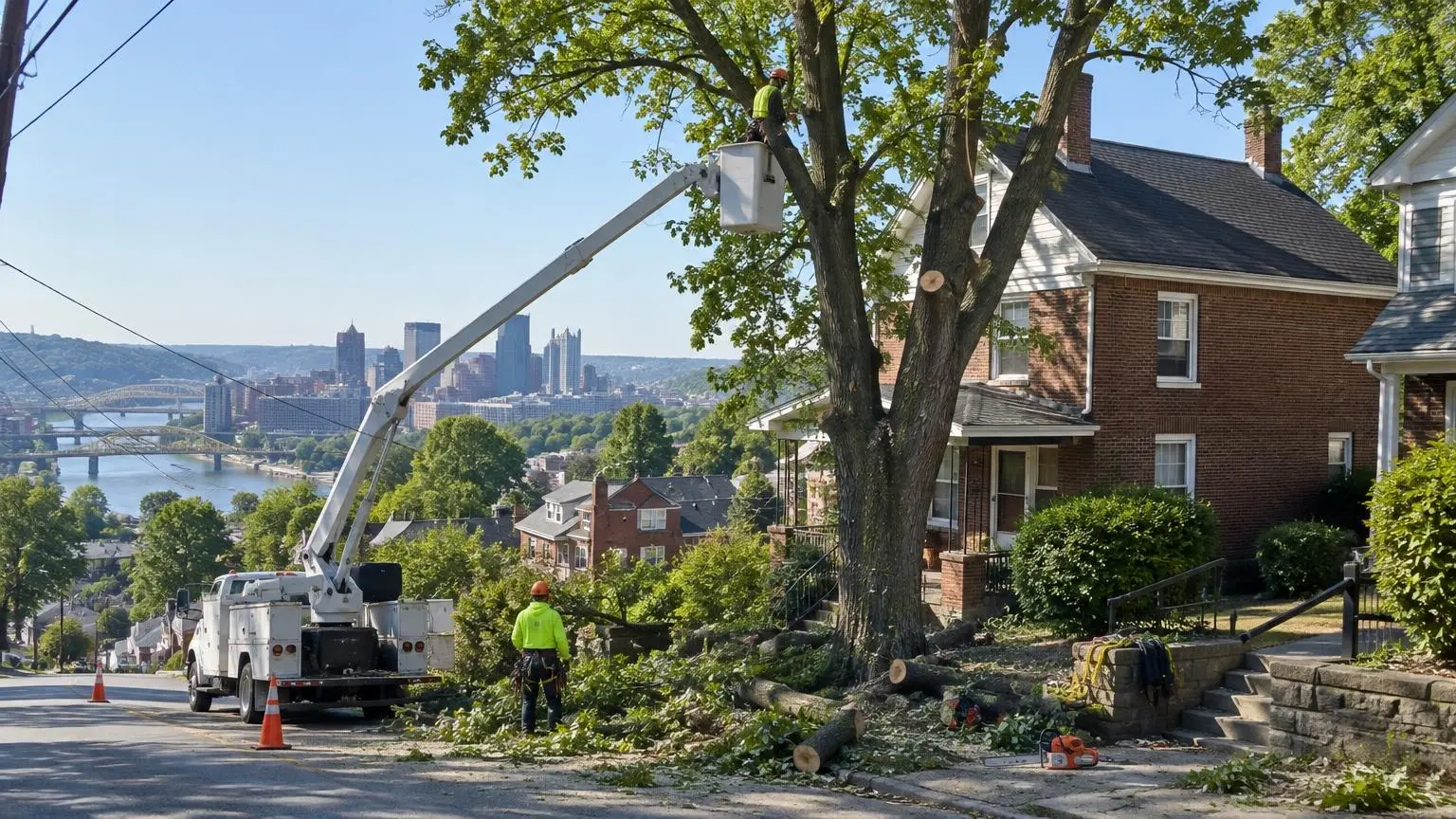
Steep banks, retaining walls and wooded slopes
Hillside Tree Removal in Pittsburgh, PA
Trees on slopes taken down in pieces that can be controlled, with the wood carried, winched or lowered out.
- Every estimate done in person around Pittsburgh and Allegheny County
- The quote spells out each tree and task
- Cleanup included and described in writing
Cutting Trees on Ground That Wants to Move
Hillside tree removal is its own kind of job in Pittsburgh. The city sits on the dissected Allegheny Plateau, with elevations from about 710 to 1,370 feet inside city limits, and a lot of homes are built into that relief: houses perched above wooded banks, backyards that drop off behind a wall, and garages at street level with the house two flights up. A tree on a 30-degree bank cannot be felled downhill without the trunk sliding, rolling or launching off the slope, and a crew cannot set ladders or a lift on it the way they would on a lawn.
Why slopes change everything
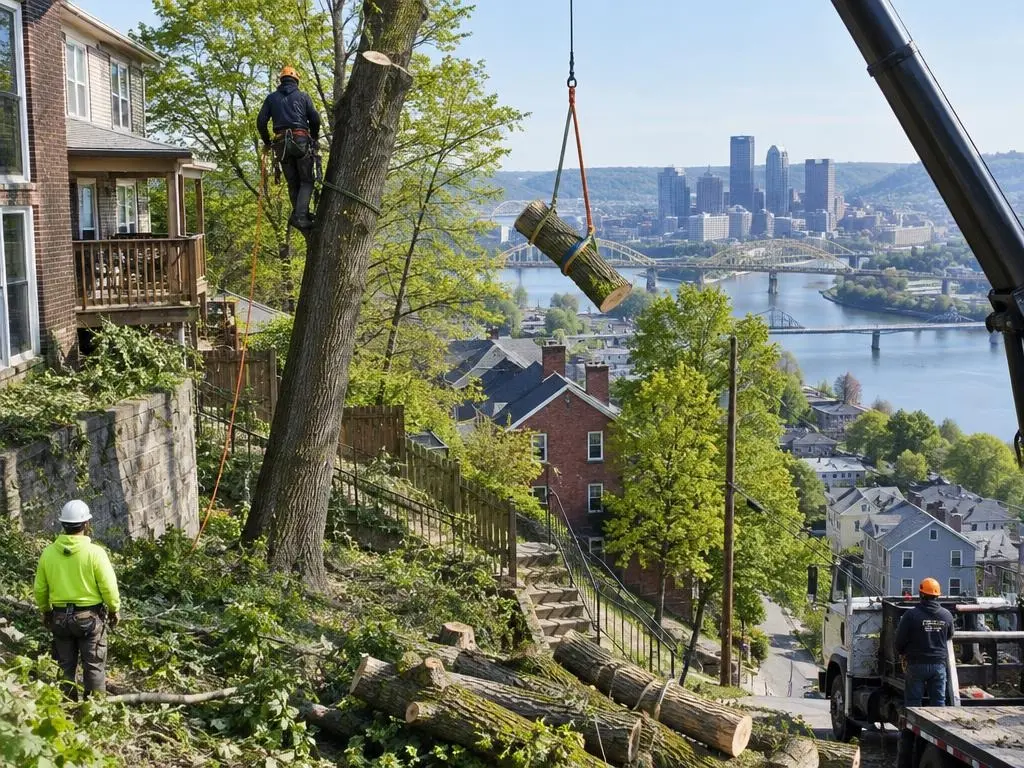
On flat ground, gravity does part of the work. On a slope it works against you. Logs that hit the ground keep moving. Brush cannot be dragged uphill easily. A dropped piece can bounce into the house below, the wall, the road, or the neighbor's back porch. So most hillside removals are climbed and rigged: each piece is cut, held on a rope, and lowered to a spot where it can stop. Sometimes the wood is winched uphill to the street, sometimes cut small enough to carry up the steps, and sometimes left on the slope in short lengths, laid across the hill, where that makes sense.
Soil, roots and landslides
Pittsburgh's steep hills, clay soils and narrow valleys have produced landslides for a long time. 2018 began as the wettest start to a year on record here, and USGS researchers tracked slope failures across the city from late February through September, ending with heavy rain from the remnants of Tropical Storm Gordon. Trees do not cause slides, but a slope that is moving tilts the trees on it, and a tree with a lifted or cracked root plate on a saturated bank is a real hazard. When we remove trees on a slope we generally leave stumps and roots in place to keep holding soil, and we do not run heavy equipment across a wet bank.
Walls and structures below the tree
A tree growing at the top of a retaining wall puts weight and root pressure on it, and its failure can take part of the wall with it. A tree at the bottom of a slope below a house can drop limbs onto the roof from above eye level. We plan these jobs around what is downhill: where each piece will land, what holds the rope, and where the ground crew stands.
Zoning on steep slopes
Pittsburgh's zoning code includes a steep slope overlay and a Hillside District, in Chapters 905 and 906, aimed mainly at development and grading. Removing a hazardous tree from an existing yard is a different matter from clearing a slope for construction, but if your project involves grading, a new structure or clearing a large wooded area, check with the city's zoning office first. Suburban municipalities in Allegheny County have their own steep-slope rules.
Knotweed, locust and tree of heaven
Wooded Pittsburgh slopes are full of fast, weedy growth: black locust, tree of heaven, Norway maple and Japanese knotweed. Clearing a few trees opens light that these species use quickly. If the goal is a clear view or a usable slope, talk with us about what comes back after the cut and how to keep the bank stable while it does.
What This Covers
Slope work is priced by what it takes to control the wood, not just by tree size.
Rigged removal on banks
Pieces cut, held on ropes and lowered to a spot where they stop.
Trees above retaining walls
Removal planned so nothing loads or strikes the wall.
Wood extraction
Logs and brush winched uphill, carried out in short pieces or left in place across the slope.
Dead and leaning slope trees
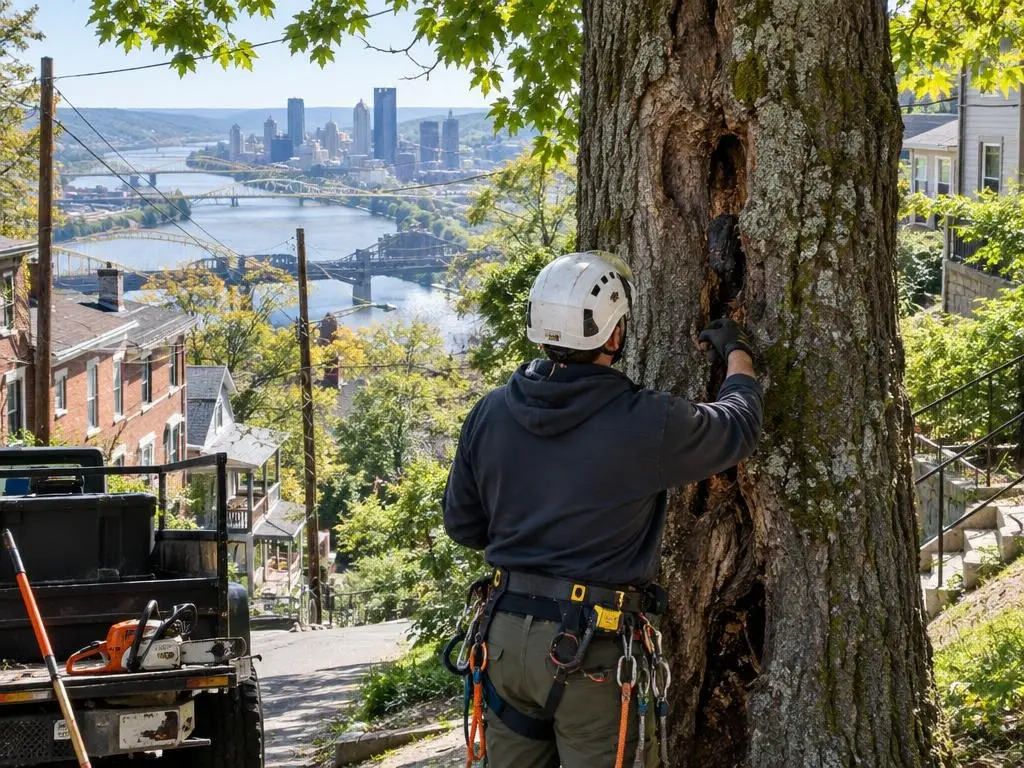
Trees tipped by moving ground or killed by pests taken down before they fall.
Selective thinning
A few trees removed for light or view while stumps stay to hold soil.
Typical Costs for Larger Removals
| Job | Published range |
|---|---|
| Tree 60 to 80 ft (Lawn Love, national) | $870 to $1,160 |
| Tree over 80 ft (Lawn Love, national) | $1,160 to $2,000 |
| Crane-assisted, medium 30 to 50 ft (ArboStar) | $2,000 to $4,500 |
| Crane-assisted, large 50 to 75 ft (ArboStar) | $3,500 to $8,000 |
| Hauling away debris (Lawn Love) | $100 to $200 |
Published guides do not price hillside work separately; these ranges from Lawn Love (2026) and ArboStar (2026) are the closest comparison. Steep ground, rigging and carrying wood out by hand add time. Your written estimate is the price.
The Process
1. Walk the slope
We look at the tree, the ground, walls and structures below, and the way out for the wood.
2. Plan the rigging
Where each piece will be lowered, what it is tied to and where the crew stands.
3. Price in writing
The method, what happens to the wood and stump, and the price.
4. Cut and lower
The tree comes down in controlled pieces, top first.
5. Clear or stage the wood
Brush chipped at the top of the slope and logs removed or left as agreed.
Hillside Tree Removal Questions
Why does a tree on a slope cost more to remove?
Because almost every piece has to be rigged and lowered instead of dropped, the crew moves slower on steep ground, and the wood often has to be carried or winched out by hand. A tree that would take a few hours on flat lawn can take a full day on a bank.
Will removing trees from my hillside cause a landslide?
Removing a tree does not usually cause a slide on its own, especially if the stump and roots are left in place. Grading, drainage changes and clearing large areas are bigger concerns. If your slope has moved before or has cracks, ask a geotechnical engineer before major clearing.
Should the stump be ground on a slope?
Usually not. Stumps and roots help hold soil, and grinders need level footing. On a bank we normally cut the stump low and leave it.
Can you remove a tree at the top of my retaining wall?
Yes. The plan keeps pieces from landing on the wall and avoids pulling roots out of the soil behind it. If the wall is already bowing or cracked, mention it when you call.
Do I need a permit to cut trees on a steep slope in Pittsburgh?
For removing a tree from an existing yard, the city's Forestry pages do not describe a private-tree permit. Steep-slope and Hillside District zoning rules mostly concern grading and development, so check with the city's zoning office if your project includes those.
Hillside Tree Removal Service Areas
- Tree Service in Pittsburgh, PA
- Tree Service in Mt. Lebanon, PA
- Tree Service in Bethel Park, PA
- Tree Service in Upper St. Clair, PA
- Tree Service in Peters Township, PA
- Tree Service in South Fayette, PA
- Tree Service in Crafton, PA
- Tree Service in Moon Township, PA
- Tree Service in Sewickley, PA
- Tree Service in Cranberry Township, PA
- Tree Service in Pine Township, PA
- Tree Service in McCandless, PA
- Tree Service in Shaler Township, PA
- Tree Service in Fox Chapel, PA
- Tree Service in Aspinwall, PA
- Tree Service in Oakmont, PA
- Tree Service in Plum, PA
- Tree Service in Penn Hills, PA
- Tree Service in Wilkinsburg, PA
- Tree Service in Monroeville, PA
- Tree Service in Murrysville, PA
Get a Hillside Tree Removal Estimate
Free estimates for slope and wall-side trees around Pittsburgh.