
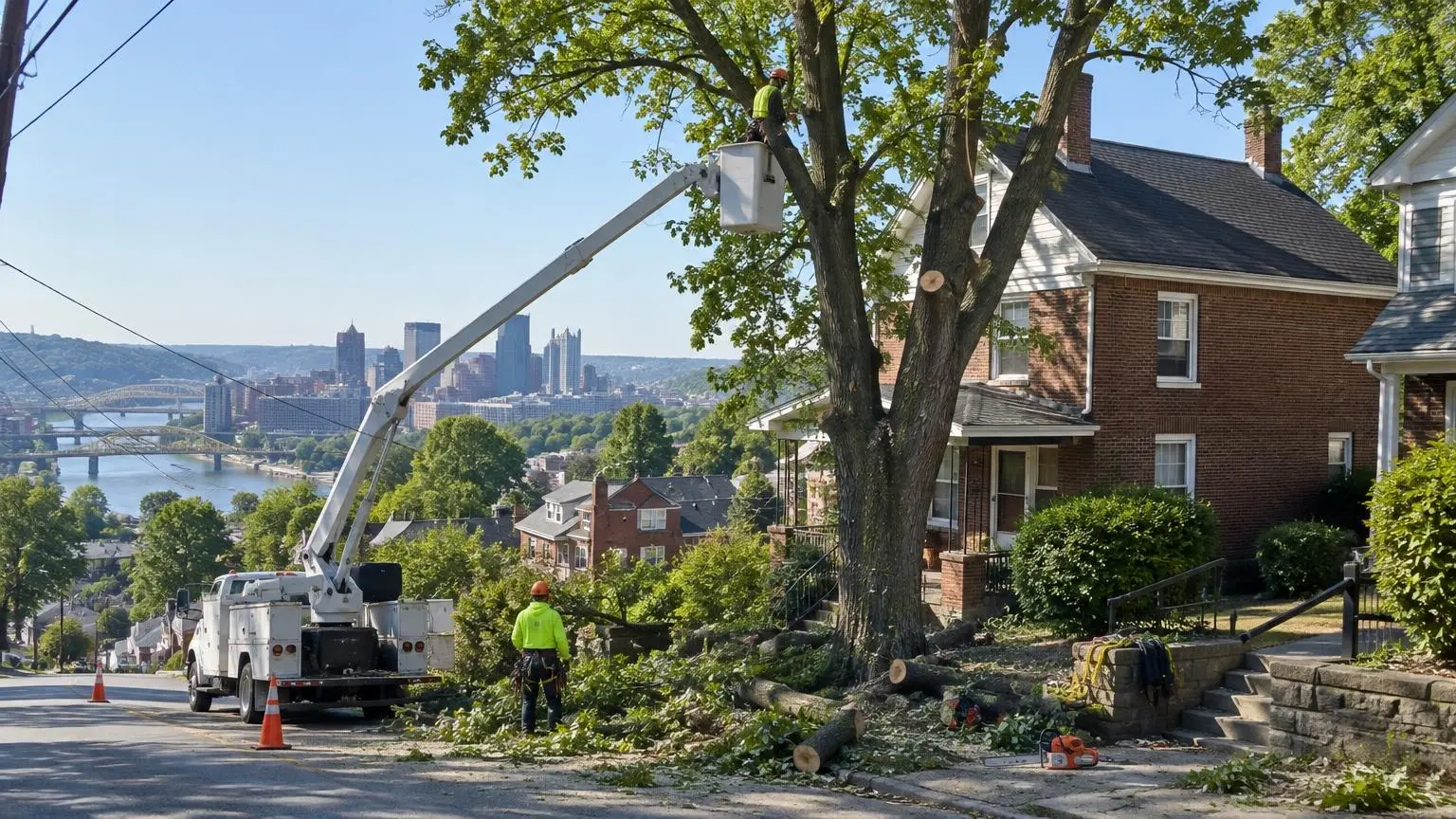
One of the fastest-growing townships in Allegheny County
Tree Service in South Fayette, PA
For homes built into the woods, and the trees the builders left behind.
- Every estimate done in person around Pittsburgh and Allegheny County
- The quote spells out each tree and task
- Cleanup included and described in writing
New Houses in Old Woods
Tree Service in South Fayette often deals with trees that were saved during construction and are now struggling. The township grew from 12,271 people in 2000 to 14,416 in 2010 and 18,394 in 2020, roughly a 50% jump in twenty years. Neighborhoods like Sterling Ridge, The Berkshires, Newbury and Forest Ridge were cut into land the township describes as mostly wooded, with small hills and floodplains along four streams.
Why saved trees decline
When a lot is graded, the trees left standing at the edge often lose part of their root system to cuts, trenches and compacted soil from heavy equipment. The damage doesn't show right away. Five to fifteen years later, the crown thins from the top down, branches die back, and a tree that looked like a selling point becomes a hazard over a deck. If your home is in one of the newer subdivisions and a big oak or maple near the house has a thinning top, that history is the first thing we consider.
Streams and soft ground
Chartiers Creek, Robinson Run and Coal Run form parts of the township's boundaries, and Millers Run takes its name from an early settler who lived at its mouth. Floodplain trees such as sycamore, silver maple and box elder grow fast in that wet ground and are prone to splitting. On a slope above a stream, the soil can stay saturated for days after heavy rain, which is when shallow-rooted trees tip.
Coal under some of it
Coal and oil were found in the township between 1860 and 1910, and mining became a major local industry. Old spoil areas and reclaimed ground can have thin, rocky soil where trees root shallowly. We take that into account when deciding whether a leaning tree is stable.
How we approach a South Fayette lot
1. Walk the edge of the lot where construction stopped and the woods begin. 2. Note which trees are dead, dying, or leaning toward the house, and which are healthy. 3. Price removals for the trees that threaten structures, and pruning for the ones worth keeping. 4. Plan wood and chip removal through the narrowest access point, since many new lots have tight side yards and fences. 5. Give you a written estimate you can approve in phases.
Growth is still coming
The township expects more building, with the Newbury Market development underway and the Southern Beltway expected to bring more residential and commercial growth. If you are building or adding on, bring us in before excavation so the trees you want to keep can be protected from root cuts and soil compaction in the first place.
Leaning trees after rain
If a tree begins to lean after several days of rain, check the ground on the side opposite the lean. Cracked, mounded or lifted soil means the roots are moving, and the tree should be treated as unsafe until it is looked at.
Call (412) 789-1968 or use the form. Get a free estimate
South Fayette Facts
- About 50% growth since 2000. The population was 12,271 in 2000, 14,416 in 2010 and 18,394 in 2020. Newer neighborhoods include Sterling Ridge, The Berkshires, Newbury and Forest Ridge.
- Wooded hills and floodplains. The township's topography is described as mostly wooded with small hills and floodplains on four streams. Chartiers Creek, Robinson Run and Coal Run form part of its boundaries.
- Coal and oil history. Coal and oil were discovered in South Fayette between 1860 and 1910, and mining became a major industry in the township.
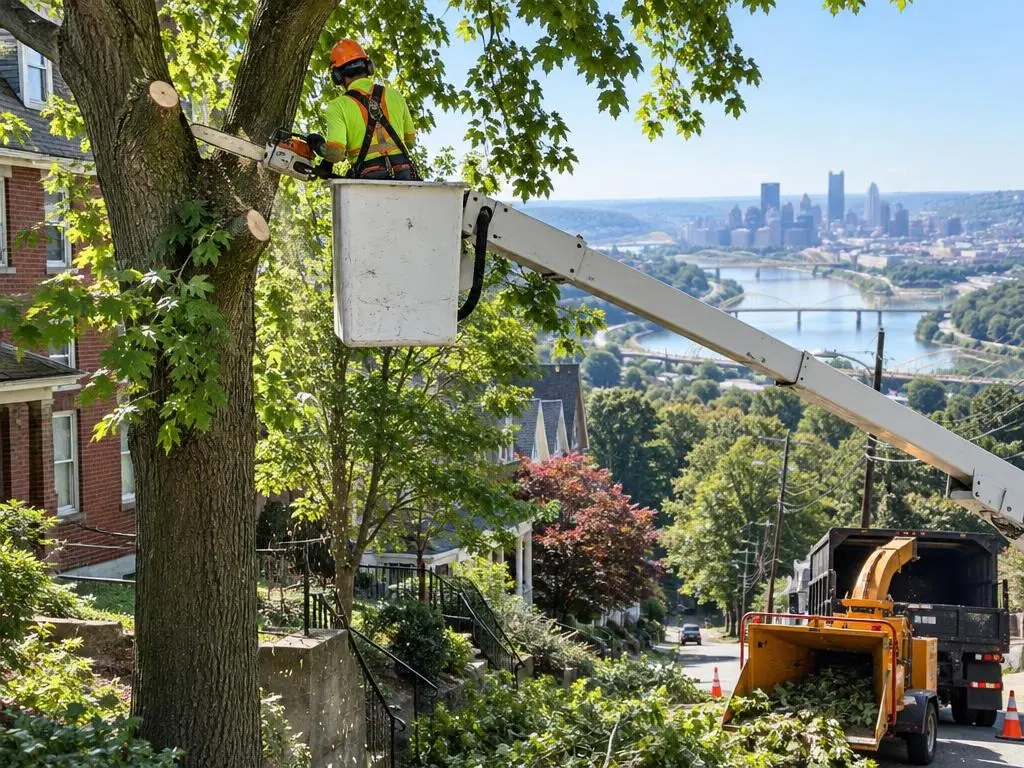
Our Services in South Fayette, PA
South Fayette Questions
The builder saved a big oak next to our house. Now its top is dying. Can it be saved?
Sometimes, if the decline is caught early and the root damage was limited. Often, though, a thinning crown years after construction means the root loss was severe. We'll look at the tree and tell you whether pruning, monitoring or removal makes sense.
We're about to build an addition. What can we do to protect our trees?
Mark a protection zone around each tree you want to keep, ideally out to the drip line, and keep equipment, material piles and trenches out of it. A quick visit before work starts helps decide which trees are worth protecting.
Our lot backs onto a creek. Are those trees our responsibility?
If they stand on your property, generally yes. Streamside trees often lean over the water and can drop into it during floods. We can prune or remove them while leaving enough roots in place to hold the bank.
Which trees grow along South Fayette's creeks, and are they weak?
Sycamore, silver maple, box elder and willow are common on the floodplains. They grow quickly in wet soil, which gives them softer wood and a habit of dropping large limbs. That doesn't mean they all need to come out, but trees over a house or driveway deserve a closer look.
Free Estimates in South Fayette, PA
Free estimates in South Fayette's older roads and newer neighborhoods alike.
Tree Service Near South Fayette
- Tree Service in Pittsburgh, PA
- Tree Service in Mt. Lebanon, PA
- Tree Service in Bethel Park, PA
- Tree Service in Upper St. Clair, PA
- Tree Service in Peters Township, PA
- Tree Service in Crafton, PA
- Tree Service in Moon Township, PA
- Tree Service in Sewickley, PA
- Tree Service in Cranberry Township, PA
- Tree Service in Pine Township, PA
- Tree Service in McCandless, PA
- Tree Service in Shaler Township, PA
- Tree Service in Fox Chapel, PA
- Tree Service in Aspinwall, PA
- Tree Service in Oakmont, PA
- Tree Service in Plum, PA
- Tree Service in Penn Hills, PA
- Tree Service in Wilkinsburg, PA
- Tree Service in Monroeville, PA
- Tree Service in Murrysville, PA